I labeled my mother's kitchen drawers like a preschool "to keep her safe"... 4 months later she took the labels off herself, and I'm the one who should be ashamed.
If you're the one your family calls when Mom repeats herself, and you've got a "memory support" brochure on your counter right now... read this before you sign anything, because I signed, and I'm going to tell you exactly what I did to her.
I'm going to start with the clock, because that's the part I can't get out of my head.

February 11th. A Wednesday. My mother in a paper gown in room 4 at Dr. Patel's office on East Beltline, with her purse on her lap and her church coat folded over it.
He handed her a clipboard and said, "Peggy, draw me a clock. Put the hands at ten past eleven."
My mother taught third grade for 34 years at Lincoln Elementary. She taught half of Grand Rapids to tell time. She drew the circle fine. Then she put all twelve numbers on the right side, bunched up like they were hiding from something, and she put the hands at ten and eleven, and she looked up at me, and she knew.
Dr. Patel looked at it for about four seconds. Then he turned his chair to me, not her, and said, "Let's talk about options."
I'm 61. I've done payroll for Vander Molen Plumbing for 23 years. I cut checks for forty men and their families, I catch the mistakes the bank misses, I know which of our guys are behind on child support and which ones are quietly putting away for retirement. I'm not a stupid woman.
And I let a man with a clipboard tell me who my mother was in four minutes. So let me tell you how a person who isn't stupid gets to that chair, because I think a lot of you are in the waiting room right now.
My mother's name is Peggy. She's 77. She raised three of us in the same house on Fuller Avenue she still lives in. She does the Sunday crossword in pen. Has since 1971. She sends 140 Christmas cards a year, every one of them handwritten, every one with a real sentence in it. When my dad died in 2020 she wrote the obituary herself, at the kitchen table, in one draft. That's who she is. Was. Is again. I'll get there.
About two years ago she started to slide.
It started with a word. Easter, two years ago. She was standing at the sink and she said, "Carol, hand me the... the thing. The... for the noodles." I said colander. She said, "I know what it's called." She didn't. I let it go.
Then the raccoon story. Thanksgiving. She told us about the raccoon in the garage. Twenty minutes later she told us about the raccoon in the garage. My brother Doug looked at me across the table. I looked at him. Neither of us said anything, and that was the moment the conversation started. Eighteen months before we had it out loud.
Then the crossword. I came over on a Sunday and it was on the kitchen table half done. Same crossword the next Sunday, same squares. And it was in pencil. My mother does not do the crossword in pencil.
Then Emma. Her granddaughter, my daughter's girl, who she has known every day of her life for nine years. Christmas. Emma ran in and my mother opened her arms and said, "There's my..." and there was a pause. A second and a half. Then, "There's my Emma." Emma didn't notice. Every adult in that room noticed.
Then the checkbook. I found three unopened envelopes from Consumers Energy in the drawer under the phone, and a shutoff notice, and my mother, who balanced that checkbook to the penny for fifty years, said the bills "must have gotten mixed up with the church mail."
Then Meijer.
Last January she called me from the parking lot of the Meijer on Knapp Street, where she has shopped every Thursday since it opened, and said, very calmly, "Carol, I can't find the car." She'd been walking the rows for forty minutes in eleven-degree weather. The car was in the row she always parks in. She was crying by the time I got there, and the first thing she said was "don't tell Doug."
My mother. In a parking lot. Telling her daughter not to tell her son.
That's what got her in the paper gown. And the clock got her the sentence, and I want you to remember the sentence, because somebody is going to say it to you. "Let's talk about options." It's the sentence that lets everybody stop looking for a reason.
We tried everything first. I need you to know that, because I need to believe it myself.
I bought her the puzzle books from Barnes & Noble. The big-print ones. She said they were for children and did two pages.
Doug bought her an iPad and put a brain-training app on it. Thirty dollars a month. She played it twice and then used the iPad as a trivet.
I got her the pill organizer with the alarm. It went off at 8 a.m. and 8 p.m. and she unplugged it because "it sounded like the smoke detector."
Dr. Patel referred her to a neurologist. The first appointment was four months out. The neurologist's PA spent eleven minutes with her, said "some of this is just age, Peggy," and told me, not her, "she's going to need supervision by the fall."
None of it stopped the slide. And I watched it every Sunday, and every Sunday I put her groceries away for her in her own kitchen.
Hold onto that. The groceries. I'm going to come back to it.
So here's what "options" turned into, because nobody tells you it doesn't start with a building. It starts in her house, with you.
Week one, I put labels on her kitchen drawers. SPOONS. FOILS & BAGS. MEDS. I printed them at work on the label maker we use for the file cabinets. I told myself it was thoughtful. My mother stood in her kitchen and read them out loud, slowly, like she was reading them to a class.
Week two, I put a bracelet on her. Stainless steel, from a website, $34. Engraved: MEMORY IMPAIRED. CALL CAROL, with my cell number. She held her wrist out for it the way a child holds an arm out for a shot. She said, "Well, at least it's pretty."
Week three, I put one of those tracking tags in the lining of her purse. I didn't tell her. Doug said it was the responsible thing.
Week four, I took the checkbook. I told her I'd "handle the bills for a while." She handed it to me across the table without a word and went to the sink and stood there with the water running.
Week five, the bridge club called. Wednesday bridge, 31 years, the same four women. Marge asked if Peggy was coming. I said, "I don't think she's up to it this week." I said it standing in my mother's kitchen. My mother was in the next room. I didn't ask her.
Week six, she stopped doing the crossword at all. The paper sat on the porch in the bag. Week seven, she stopped answering her phone. "Let Carol get it." Carol was at work.
Week eight, she said, "Don't bring the kids Sunday, Carol. I don't want Emma to see me like this."
Like what, Mom.
"Like this."
And I had a folder on my counter from a place on the north side called The Willows. "Memory support residences." A courtyard. A "life enrichment calendar." Seven thousand nine hundred a month. I'd already written the wait-list deposit. Four thousand two hundred dollars. It was in the folder with a paper clip on it.
I want to be honest about something. By March I'd started to believe it. That's what the word "options" does to you. It comes with a folder and a courtyard and a woman on the phone who says "transition" in a calm voice, and you start nodding along while your mother turns into somebody who reads her own drawers out loud. I nodded. God help me, I nodded.
Here's where it turned, and it didn't turn because of me. It turned because of a hairdresser named Donna.
Donna has done my mother's hair every other Thursday for 26 years at a shop on Plainfield Avenue with three chairs and a gumball machine. I'd started driving Mom there and sitting in the waiting chair, because I didn't trust her to find it anymore.
One Thursday in March, Mom was under the dryer and Donna came and sat down next to me with her coffee.
She said, "You're Peggy's daughter."
I said yes.
She said, "Can I tell you something her doctor's not going to tell you?"
I said please.
She said, "Your mother isn't losing her mind. She's foggy. There's a difference, and I've been looking at the difference for 26 years."
I thought she'd overstepped. I'll be honest.
She said, "I've got a woman in my two o'clock chair who's 88. Tells me every grandkid's birthday, every one, and she's got eleven. Your mom's 77. Last week she couldn't find the word for hairspray. Same town. Same church. Same water out of the same tap. You want to tell me that's age? One of them's 88 and sharp as a tack and one of them's 77 and can't say hairspray. Nobody's been able to tell me why, and I've been asking for 26 years."
I didn't have anything to say to that.
Then she told me about her own mother, who went foggy the same way and got the same folder, and about a client of hers who's a night nurse who'd shown her an article by a former NASA doctor. He'd spent years working out why some seniors are sharp at 88 while others start losing words at 70.
She said it comes down to five foods. Five specific things sitting in almost every American kitchen. She said the #1 worst one is in 99 out of 100 homes, and it clogs up something in the brain that's supposed to clean itself out every night while you sleep, and it does it so slowly that by the time anybody notices, every doctor in town is calling it age.
And then she said the thing I still hear.
She said, "Honey, I see what your mother pulls out of that purse to snack on under my dryer. And I see the Meijer bags in the back seat of your car."
She pulled out her phone and sent me the article right there, and got up to take Mom out from under the dryer.
I drove home furious. A hairdresser telling me, a woman who's balanced a company's books for 23 years, about my mother's brain. I'd already had Dr. Patel and the neurologist's PA and the woman from The Willows explain my mother to me. I did not need a woman with a coffee cup and a gumball machine. I didn't open it.
Two weeks went by.
What made me open it was the bridge club. Marge called again, and I said the same thing, "she's not up to it," and I hung up, and I turned around, and my mother was standing in the doorway of her own kitchen, and she'd heard me. And she didn't argue. She just went and sat down in her chair.
That's the one I can't take back. Not the labels. Not the bracelet. That she heard me say it and didn't argue.
That night I sat down at her kitchen table, in her chair, in front of the half-done crossword, and I opened Donna's article on my phone.
I read it twice. Then I put the phone face down on the table.
I'm not a doctor. I do payroll. But this doctor wrote it plain enough for a payroll clerk, so let me give you the shape of it the way I understood it.
He said your brain has a rinse cycle. Every night, in deep sleep, it switches on and flushes out the residue from a full day of thinking and remembering. It's built to do that every night into your 80s and 90s, unless something clogs it.
He said these five foods clog it. A little more residue gets left behind every morning, more than the rinse can clear, and it builds. And it takes your sharpness in an exact order. Words first. Then names. Then the thread of the story. Then where you parked the car. The colander. The raccoon. Emma. The Meijer lot. In that exact order.
He said it never shows up on the blood work they run at a checkup, and nobody in a doctor's office is trained to ask what's in the pantry. So they hand you a clipboard, they look at the birth date, and they say the words. Normal for her age. Let's talk about options.
And he said one of the five does more damage than the other four put together. Get that one out of the house and the other four lose most of their grip.
Then he listed them.

I got up from my mother's table and opened her pantry, and three of the five were on the shelves in front of me. One of them was open.
And here is the part I have to live with.
I bought them.
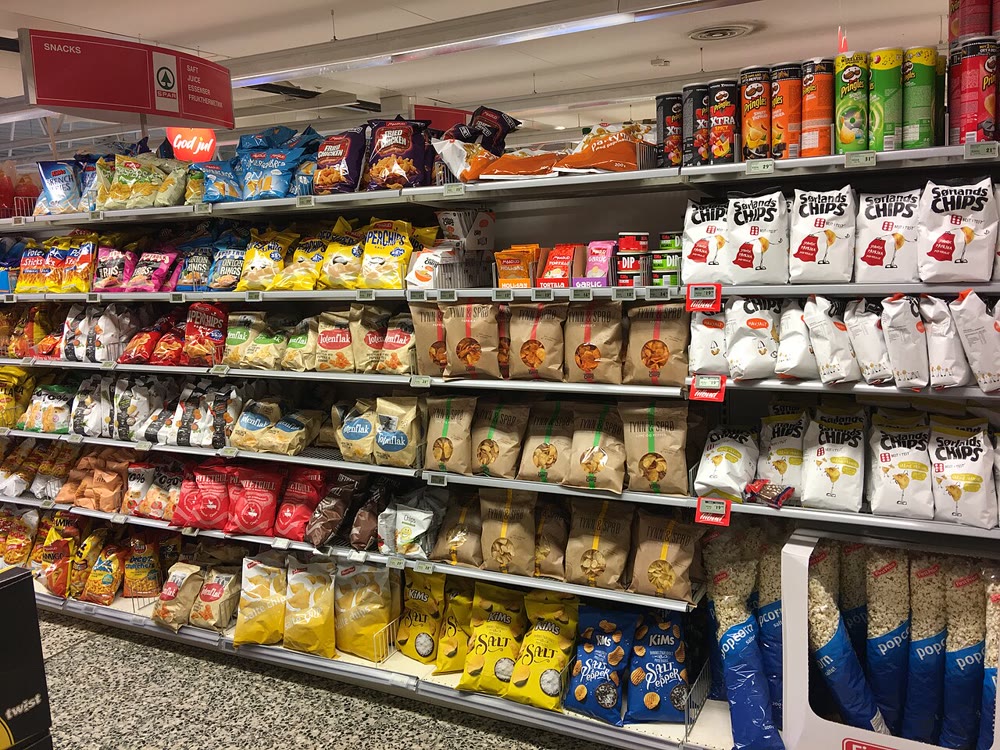
Every Thursday for six years, since Dad got sick, I have done my mother's shopping at the Meijer on Knapp Street. I'm the one who put them in the cart. I'm the one who carried them in and put them on her shelves, in the drawers I'd labeled. And every Thursday for the last two months I'd been packing two of them in her purse for the salon, because she "liked a little something under the dryer," and Donna had watched me do it.
I sat back down in her chair and I put my head down on the crossword and I cried until I couldn't breathe. The kind you only do when there's nobody in the house.
I'm not going to tell you which three. I'm not going to tell you #1. The article does that better than I can, and when I saw what #1 was I said my mother's name out loud in her empty kitchen, because I'd been buying it for her since I was old enough to push a cart.
Then I did something about it.
I couldn't undo the bracelet. I couldn't undo what she'd heard me say to Marge. But I could control what came into that house on Thursdays. And I could clear three shelves. And I could pack a different purse.
Here's what happened, exactly as it went, because you won't believe it and I wouldn't have either.
The first week, nothing. Donna said, "Give it time, honey. It took years to do this to her."
The second week the crossword was finished. In pencil. But finished, all of it, on the table on Sunday morning when I came in.
The third week she said "colander." I didn't ask for it. She was at the sink and she said, "Carol, hand me the colander," and I handed it to her, and I went out to the porch and sat down.
The fourth week she called me. On a Tuesday. At work. She wanted to know if the plumbing company was still using that awful payroll software, and she wanted to hear about my day.
Week five she asked for her checkbook back. She said, "I'd like to see what you've been doing with it." I handed it across the table. She found a $14 mistake I'd made on the water bill.
Week six she went to bridge. I didn't drive her. She drove herself. She came home and told me Marge had cheated, which Marge has been doing since 1994.
Week seven the crossword was in pen.
Week eight, she was at my kitchen table on a Sunday with the church bulletin, and she turned it over and drew a clock on the back of it. Twelve numbers, evenly spaced, the way she'd taught two thousand third-graders to do it. Hands at ten past eleven. She slid it across the table to me and she didn't say a word.
That clock is on my refrigerator right now, under the magnet from Emma's school. I don't know why I keep it. I think it's so I remember who handed her the clipboard.
Week nine, the labels came off the drawers. She peeled them off herself while I was there and put them in a neat stack on the counter, and said, "I believe I know where my spoons are, Carol."
Month three, she asked me to help her with the clasp on the bracelet, and I thought she wanted it tightened, and she took it off and dropped it in the junk drawer. The drawer that used to say MEDS.
Month four, in June, I tore up the wait-list deposit check from The Willows at her kitchen table, and she watched me do it, and then she took the pieces and put them in the trash under the sink because "a table isn't a wastebasket."
She's 77. She's in her own house on Fuller Avenue. Last Sunday she did the crossword in pen at the table while Emma sat on her lap, and she got 14 across before I did, and she made sure I knew it. She's started the Christmas card list. In her handwriting. All 140.
My brother Doug tells people the "routine" is what did it. The pill alarm. The structure. He said it at Easter with his mouth full.
I've stopped arguing with him. Donna says it isn't worth it. Donna says she's got a whole appointment book full of Dougs, and every one of them is sure it was the iPad.
I'm writing this because I know some of you are the daughter.
You're the one with the folder on the counter.
You're the one who gets the call from the parking lot.
You're the one who does her shopping every Thursday, and puts the groceries away in her kitchen, and thinks that's love. I thought it was love.
You're the one who's going to say "she's not up to it" while she's standing in the doorway.
Before you do, read what this NASA doctor found about these five foods.
The article lays out all five. It tells you where they hide in her kitchen, and probably in yours. And it holds the #1 worst one for the very end, because that's the one that matters most, and I promise you it's in her pantry right now, and you're the one who bought it. I was.
Read it for #1. That's the one I carried into her house every Thursday for six years and then packed in her purse for the salon.
It costs you nothing to read. It cost my mother a bracelet and a bridge club and eight weeks of reading her own drawers out loud, and it cost me a $4,200 check I'm glad I never had to cash.
Take the labels off before you ever put them on.
Take the labels off before you ever put them on.
THIS IS AN ADVERTORIAL AND NOT AN ACTUAL NEWS ARTICLE, BLOG, OR CONSUMER PROTECTION UPDATE.
The story depicted on this page and the people depicted in it are illustrative and are not actual news. Names, places and details are composites. Photographs are licensed stock or illustrative images and do not depict the people described. This page may receive compensation for clicks on or purchases of products featured on linked pages.
This website is not intended to provide medical advice or to take the place of medical advice and treatment from your personal physician. Visitors are advised to consult their own doctors or other qualified health professionals regarding the treatment of medical conditions. These statements have not been evaluated by the Food and Drug Administration. No product is intended to diagnose, treat, cure, or prevent any disease.